


Packing and Sorting Equipment: How to Build an Efficient End-of-Line Automation System

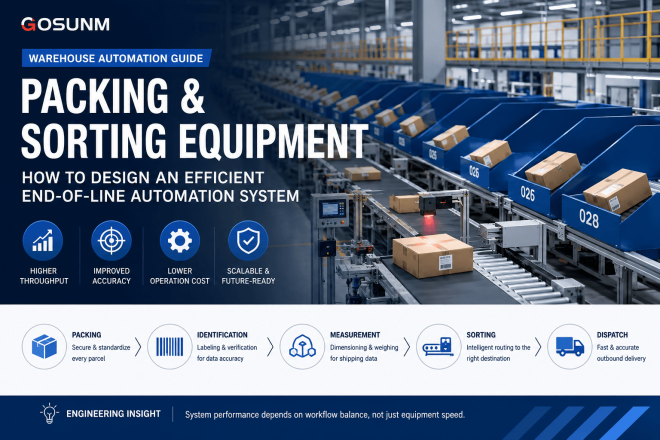
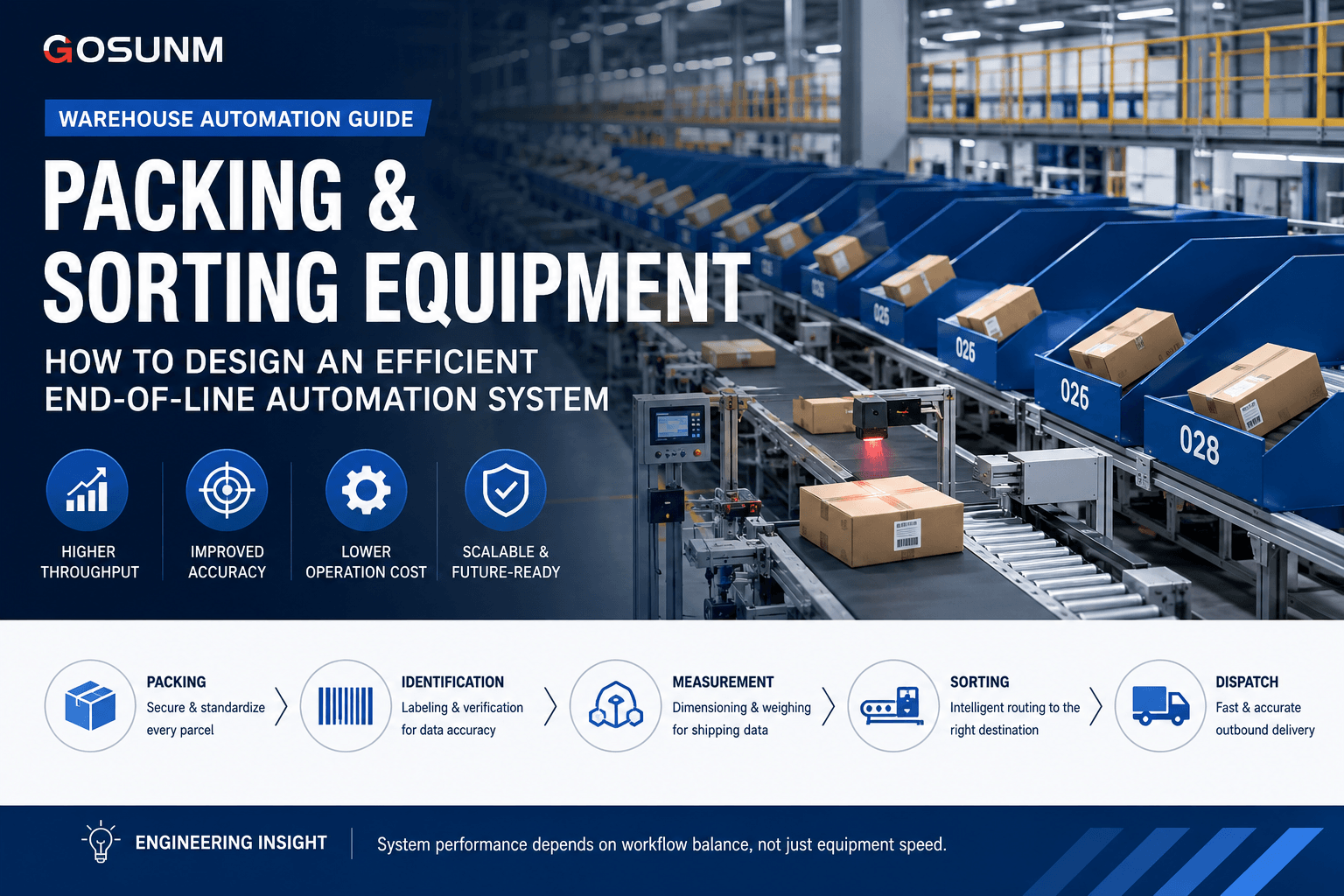
Packing and sorting equipment is no longer just a collection of standalone machines. In today's high-volume distribution centers, packaging, barcode verification, dimensioning, weighing, conveying, sorting, and shipping must function as one synchronized material flow. Investing in a faster sorter or a more advanced packing machine alone rarely solves operational bottlenecks if upstream and downstream processes remain unbalanced.
Whether you operate an e-commerce fulfillment center, a parcel hub, or a third-party logistics warehouse, selecting equipment based only on speed or price can lead to underutilized assets, excessive manual intervention, and expensive system upgrades.Introduction
Warehouse automation has entered a new stage. Instead of asking "Which machine should I buy?", logistics companies are increasingly asking "How should my entire packing and sorting process work?"
This shift is driven by several industry trends, Order profiles are becoming more complex as customers expect same-day or next-day delivery. Parcel sizes vary significantly due to SKU diversification, while labor shortages continue to increase operating costs. Seasonal sales events such as Black Friday and Singles' Day also require warehouses to process several times their normal order volume without compromising delivery accuracy. These challenges cannot be solved by replacing a single machine. They require an integrated end-of-line automation strategy where every process—from packing to truck loading—is engineered as one connected workflow, This article provides a practical framework for designing that workflow.
Why Packing and Sorting Should Be Planned as One Integrated System?
Looking Beyond Individual Machines
Many automation projects begin with a request for quotation for a carton sealer, conveyor, or parcel sorter. Although these machines perform different tasks, purchasing them separately often results in operational inefficiencies because they are designed without considering how parcels move through the warehouse.
An automated packing line does not end when a carton is sealed. From that moment, every parcel enters a continuous material flow where barcode readability, package stability, conveyor spacing, weighing accuracy, and sorting logic become closely interconnected.
If one stage performs poorly, every downstream process is affected.
This is why experienced warehouse planners evaluate the complete parcel journey instead of comparing individual equipment specifications.
Every Process Influences the Next One
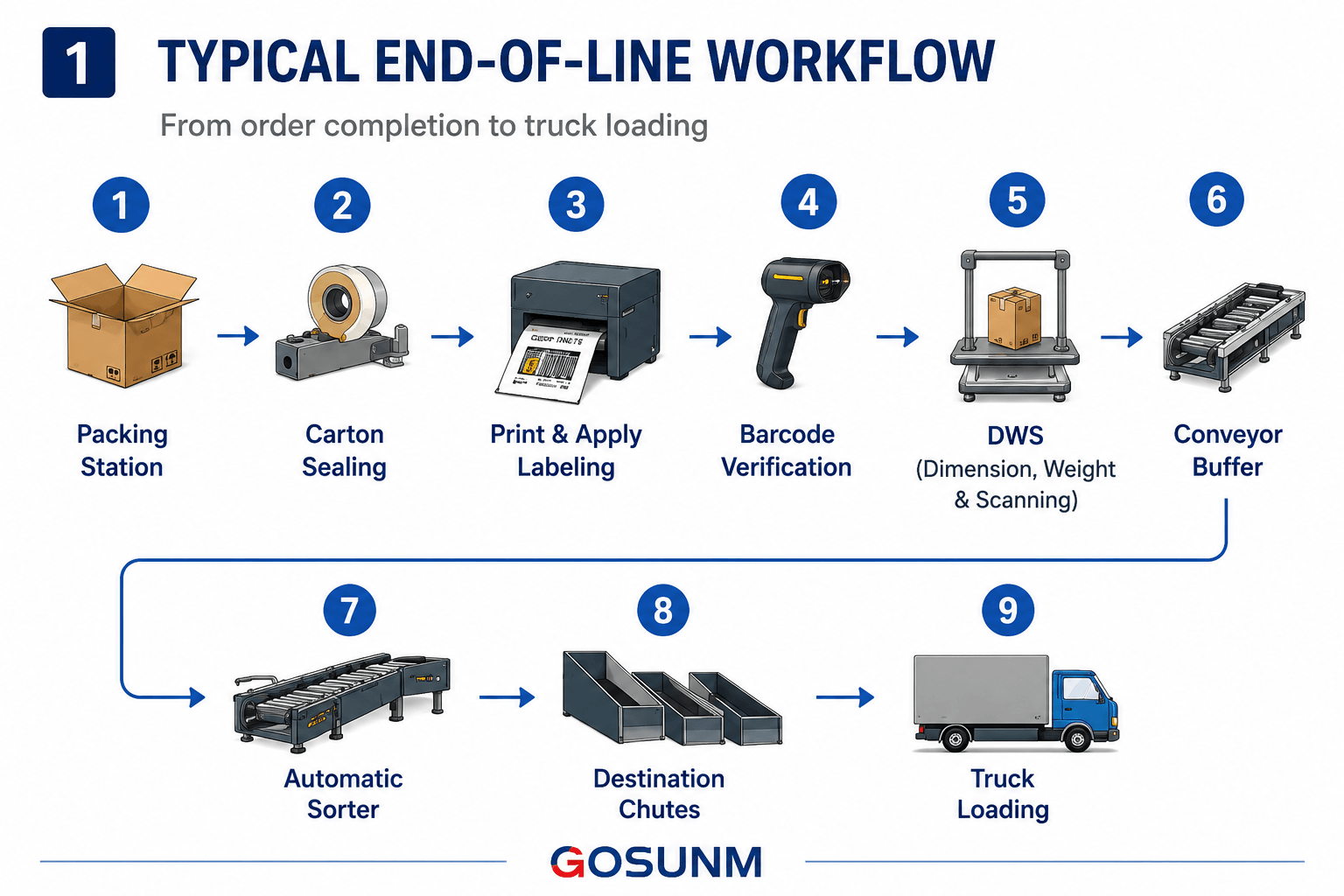
A finished parcel typically passes through several operations before leaving the warehouse.
A carton that is poorly sealed may become unstable on conveyors.
An incorrectly positioned shipping label may reduce barcode readability.
Uneven parcel spacing may lower sorter efficiency.
Delayed packing output may cause an expensive sorting system to wait idle.
None of these problems originate from the sorter itself, yet all of them directly affect sorting performance.
This demonstrates a fundamental engineering principle:
Warehouse performance depends on workflow coordination rather than machine speed.
Material Flow Is More Important Than Equipment Speed
Many buyers compare maximum throughput when evaluating suppliers.
For example:
Supplier A offers: 6,000 parcels/hour
Supplier B offers: 8,000 parcels/hour
The second option appears better.
However, imagine the upstream packing process can only release 4,200 parcels every hour.
In practice:
The 8,000 PPH sorter will never exceed 4,200 PPH because upstream operations become the limiting factor.
The investment difference produces almost no operational improvement.
Engineers therefore evaluate the entire material flow before selecting equipment.
Practical Example
A regional e-commerce fulfillment center planned to increase capacity from 25,000 to 40,000 parcels per day.
Management initially requested a larger sorting system.
During site analysis, engineers discovered the actual bottleneck was manual carton sealing and inconsistent label application.
Although the sorter still had available capacity, operators frequently stopped conveyors to correct damaged labels and reseal cartons.
Instead of replacing the sorter, the warehouse upgraded:
- Automatic carton sealing
- Print-and-apply labeling
- Barcode verification
- Conveyor accumulation
The result:
- 35% higher throughput
- Reduced manual intervention
- Improved sorting accuracy
- Lower operating costs
without purchasing a larger sorter system.
Expert Tip
Always identify the bottleneck before investing in additional automation.
In many warehouses, increasing sorter speed does not improve overall productivity because constraints exist much earlier in the process.
Engineering Note
The maximum rated throughput of a sorting system should never be used as the expected daily operating throughput. Actual performance depends on induction efficiency, parcel spacing, barcode quality, destination distribution, software logic, maintenance practices, and operator consistency.
Key Takeaways
✔ Packing and sorting should be designed together.
✔ Material flow determines warehouse efficiency.
✔ Faster equipment does not automatically increase throughput.
✔ Bottlenecks should always be identified before purchasing new equipment.
What Equipment Is Included in a Modern Packing and Sorting Line?
Packing Station
Packing begins after order picking has been completed.
Operators—or robotic packing cells—select appropriate cartons, place products inside, add protective materials when necessary, and prepare parcels for shipment.
Good packing practices improve more than presentation.
They ensure:
- Stable parcel dimensions
- Consistent weight distribution
- Reduced product damage
- Reliable downstream conveying
Packaging quality is therefore the foundation of automation performance.
Automatic Carton Sealing
Once cartons are packed, sealing equipment ensures every package is securely closed using tape or water-activated paper tape.
Beyond labor savings, automatic sealing provides:
- Consistent sealing quality
- Uniform carton dimensions
- Higher conveyor stability
- Better scanning conditions
Poorly sealed cartons frequently deform during conveying, increasing the probability of barcode reading failures.
Print-and-Apply Labeling
Shipping labels connect physical parcels with digital order information.
Automatic print-and-apply systems ensure labels are positioned consistently according to predefined standards.
Benefits include:
- Higher barcode readability
- Improved parcel traceability
- Reduced labeling errors
- Faster downstream processing
Incorrect label placement remains one of the most common causes of manual exception handling in automated warehouses.
Barcode Verification
Applying a label is only the first step.
Warehouses should immediately verify barcode quality before parcels enter high-speed conveying systems.
Verification systems detect:
- Missing labels
- Damaged labels
- Low barcode contrast
- Incorrect shipment information
Detecting problems early prevents downstream sorting interruptions.
Dimensioning and Weighing (DWS)
Dimensioning and Weighing Systems automatically collect:
- Length
- Width
- Height
- Weight
- Barcode information
These data support:
- Shipping cost calculation
- Carrier compliance
- Warehouse Management Systems
- Sorting logic
- Inventory visibility
Modern DWS systems also reduce manual data entry while improving operational accuracy.
Conveyor System
Conveyors transport parcels between every process while maintaining stable spacing and continuous material flow.
A properly designed conveyor system should provide:
- Accumulation
- Buffering
- Speed synchronization
- Smooth transfers
- Minimal parcel rotation
Rather than simply moving cartons, conveyors regulate workflow across the entire automation system.
Automatic Sorting System
The sorter identifies each parcel's destination and automatically diverts it to the correct shipping lane.
Technology selection depends on:
- Parcel characteristics
- Throughput requirements
- Number of destinations
- Available floor space
- Expansion plans
Choosing the correct sorting technology requires evaluating the complete workflow rather than comparing sorter specifications alone.
Destination Chutes and Truck Loading
The final stage groups parcels according to carrier, delivery route, or destination before loading.
Even this seemingly simple operation affects warehouse productivity.
Poor chute design can create parcel congestion, while inefficient loading layouts may eliminate productivity gains achieved throughout the automation system.
For this reason, experienced system designers always evaluate the end-of-line process as one continuous workflow rather than independent machines.
Choosing Packing Equipment Based on Operational Requirements
Start with the Operation, Not the Machine
One of the most common purchasing mistakes is selecting packing equipment based on product catalogs instead of warehouse operations.
For example, an automatic carton sealer capable of processing 1,200 cartons per hour may appear impressive on paper. However, if the warehouse only processes 350 cartons per hour with frequent product changes, the investment may never deliver an acceptable return.
Effective equipment selection begins with understanding operational requirements rather than technical specifications.
Warehouse planners should first evaluate:
- Daily and peak order volume
- Parcel types (cartons, poly bags, padded mailers)
- Product fragility
- SKU diversity
- Required packing speed
- Labor availability
- Packaging materials
- Future business growth
Only after these factors are clearly defined should individual equipment be compared.
Matching Equipment to Warehouse Profiles
Different warehouse environments require different packing strategies.
| Warehouse Type | Recommended Packing Configuration | Primary Objective |
|---|---|---|
| Small e-commerce warehouse | Manual packing with semi-automatic sealing | Flexibility |
| Medium fulfillment center | Automatic sealing + print-and-apply labeling | Higher productivity |
| High-volume parcel hub | Fully integrated packing line | Maximum throughput |
| 3PL warehouse | Modular equipment with flexible configuration | Adaptability |
| Omnichannel distribution center | Scalable packing cells integrated with WCS | Mixed order processing |
Rather than asking which machine is "best," warehouse planners should determine which configuration best supports their operational model.
Packaging Quality Directly Affects Automation
Packing quality is often underestimated because it appears to be a manual task.
In reality, poor packaging is one of the leading causes of downstream automation problems.
Examples include:
- Cartons that collapse under conveyor pressure
- Excessive tape covering shipping labels
- Loose contents causing unstable weight distribution
- Overfilled cartons changing external dimensions
- Irregular poly bags rotating unpredictably
Each of these conditions increases exception handling, reduces barcode readability, and lowers sorting efficiency.
Well-designed packing processes create consistent parcels that are easier to scan, weigh, convey, and sort automatically.
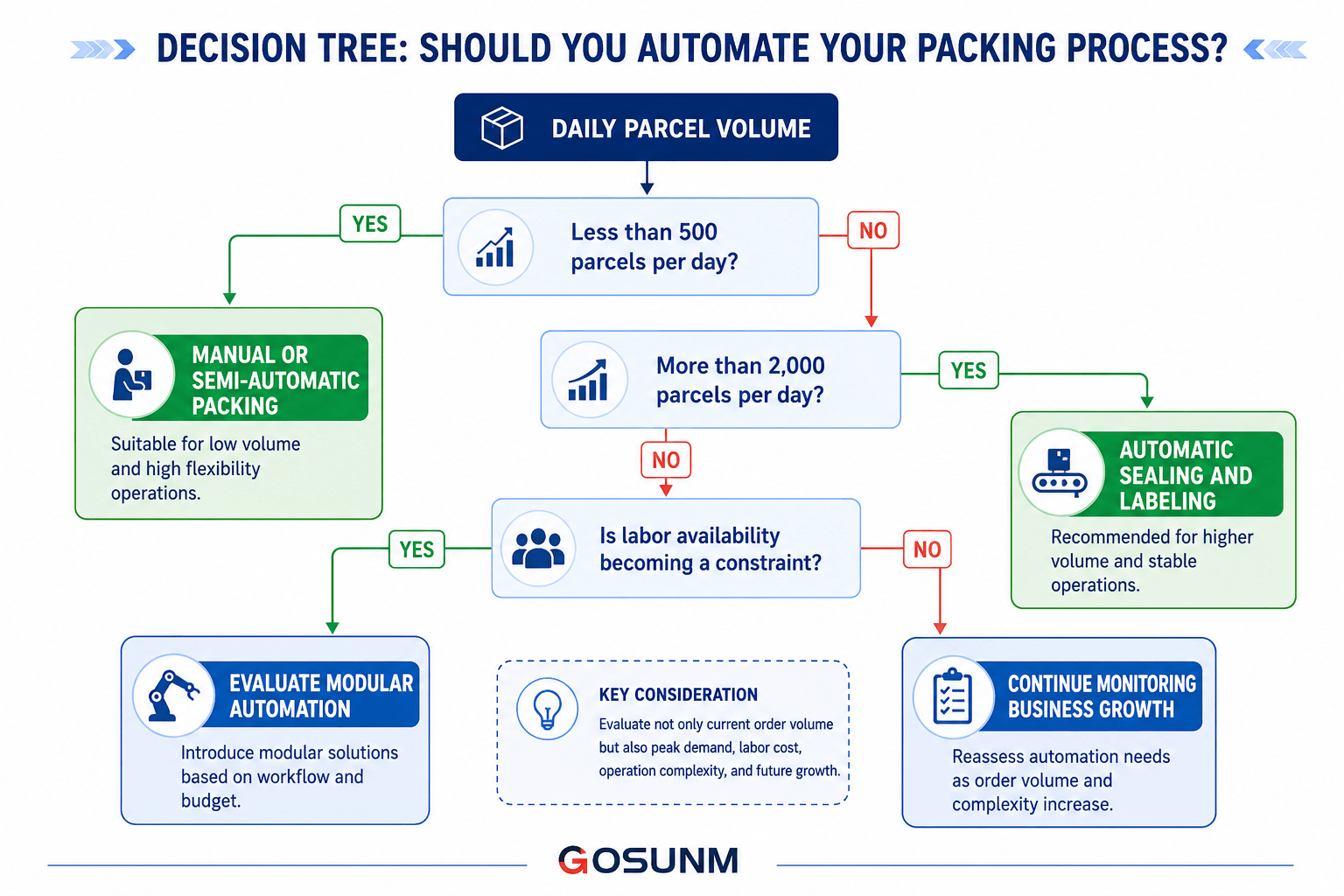
Decision Framework: When Should You Automate Packing?
Frequently Asked Questions
1. What is the difference between packing equipment and sorting equipment?
Packing equipment prepares parcels for shipment by completing tasks such as carton forming, sealing, labeling, and packaging quality control. Sorting equipment automatically identifies each parcel's destination and diverts it to the correct outbound lane. Although they perform different functions, they should be planned as one integrated end-of-line system because packing quality directly affects barcode scanning, conveying, and sorting performance.
2. How do I know if my warehouse needs automated packing equipment?
Automation becomes a practical option when manual packing limits warehouse throughput, labor costs continue to increase, or order volumes fluctuate significantly during peak seasons. Instead of using daily order volume alone, evaluate peak-hour demand, labor availability, packaging consistency, and expected business growth before deciding whether to automate.
3. Which sorting technology is best for mixed parcel sizes?
There is no universal answer. Cross Belt Sorters are generally suitable for warehouses handling a wide variety of cartons, poly bags, and irregular parcels because they offer excellent handling flexibility. Narrow Belt Sorters are often preferred for standard cartons with high throughput requirements, while Wheel Sorters are commonly used in medium-speed applications with limited budgets. Equipment selection should always be based on parcel characteristics, throughput targets, destination quantity, and available floor space rather than equipment speed alone.
4. How is the required sorting capacity calculated?
Sorting capacity should be based on peak-hour order volume instead of average daily shipments.
A simplified planning formula is:
Required Throughput = Peak Hour Orders ÷ Operating Hours × Safety Factor
Most system designers also reserve additional capacity for future business growth, seasonal peaks, and temporary equipment downtime.
5. Should dimensioning, weighing, and barcode scanning be completed before sorting?
Yes. Most automated warehouses position the DWS (Dimensioning, Weighing, and Scanning) system before the sorter. Collecting accurate parcel data before sortation allows the Warehouse Control System (WCS) to make correct routing decisions, calculate shipping charges, and reduce manual exception handling.
6. What information should be prepared before purchasing packing and sorting equipment?
Before contacting suppliers, warehouse managers should prepare:
- Daily and peak order volumes
- Parcel dimensions and weight ranges
- Carton and poly bag ratio
- Number of sorting destinations
- Warehouse layout drawings
- Future business growth expectations
- Required software integration (WMS, WCS, ERP)
- Target project budget
Providing this information allows suppliers to recommend solutions based on operational requirements instead of generic equipment specifications.
7. Can one packing and sorting line process both cartons and poly bags?
Yes, but system design becomes more challenging. Mixed parcel profiles require appropriate conveyor design, scanning technology, and sorting equipment capable of handling different shapes and weights. Additional testing is often recommended to verify stability, barcode readability, and sorting accuracy before implementation.
8. How much warehouse space is required for an automated packing and sorting system?
Space requirements vary depending on throughput, equipment type, destination quantity, and future expansion plans. Rather than designing only for current production, engineers usually reserve additional space for maintenance access, conveyor accumulation, and future capacity increases. A detailed layout study is recommended before selecting equipment.
9. Is software integration more important than equipment speed?
In many projects, yes.
Warehouse Control Systems (WCS) coordinate conveyors, scanners, DWS equipment, sorters, and printers in real time. Even high-speed equipment cannot operate efficiently if software cannot synchronize parcel flow, routing logic, and exception handling. For this reason, software architecture should be planned together with mechanical equipment from the beginning of the project.
10. How can I reduce bottlenecks in a packing and sorting system?
Most bottlenecks originate from workflow imbalance rather than insufficient equipment speed. Common improvements include adding conveyor buffer zones, optimizing merge logic, standardizing label placement, improving packaging consistency, and synchronizing upstream and downstream processes through the WCS. Before investing in faster machines, conduct a complete material flow analysis to identify the true operational constraint.
11. How can I future-proof my packing and sorting system?
Choose a modular system that allows additional sort destinations, conveyor extensions, software upgrades, and equipment expansion without redesigning the entire layout. Planning for expected business growth during the initial design stage is usually more cost-effective than retrofitting a fully occupied system later.
12. What should I look for when comparing different sorting equipment suppliers?
Instead of comparing only equipment specifications, evaluate each supplier's engineering capabilities, project experience, software integration expertise, after-sales support, spare parts availability, commissioning process, and ability to customize solutions for your operational requirements. A supplier that understands your warehouse workflow often delivers greater long-term value than one offering the highest advertised machine speed.


 Privacy settings