


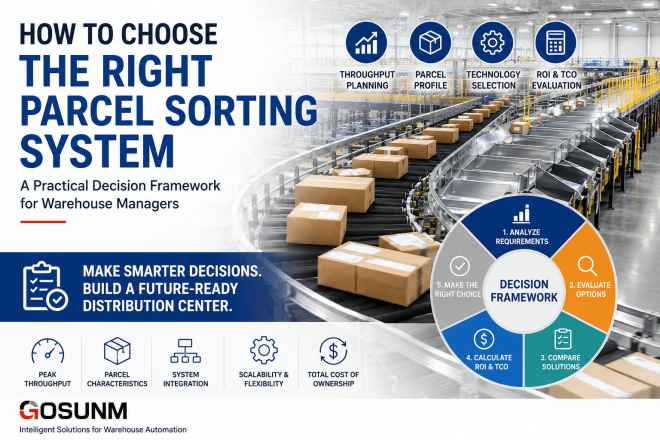
How to Choose the Right Parcel Sorting System: A Practical Decision Framework for Warehouse Managers

- Step 1:Define Your Business Requirements Before Looking at Equipment
- Step 2: Understand Your Parcel Profile
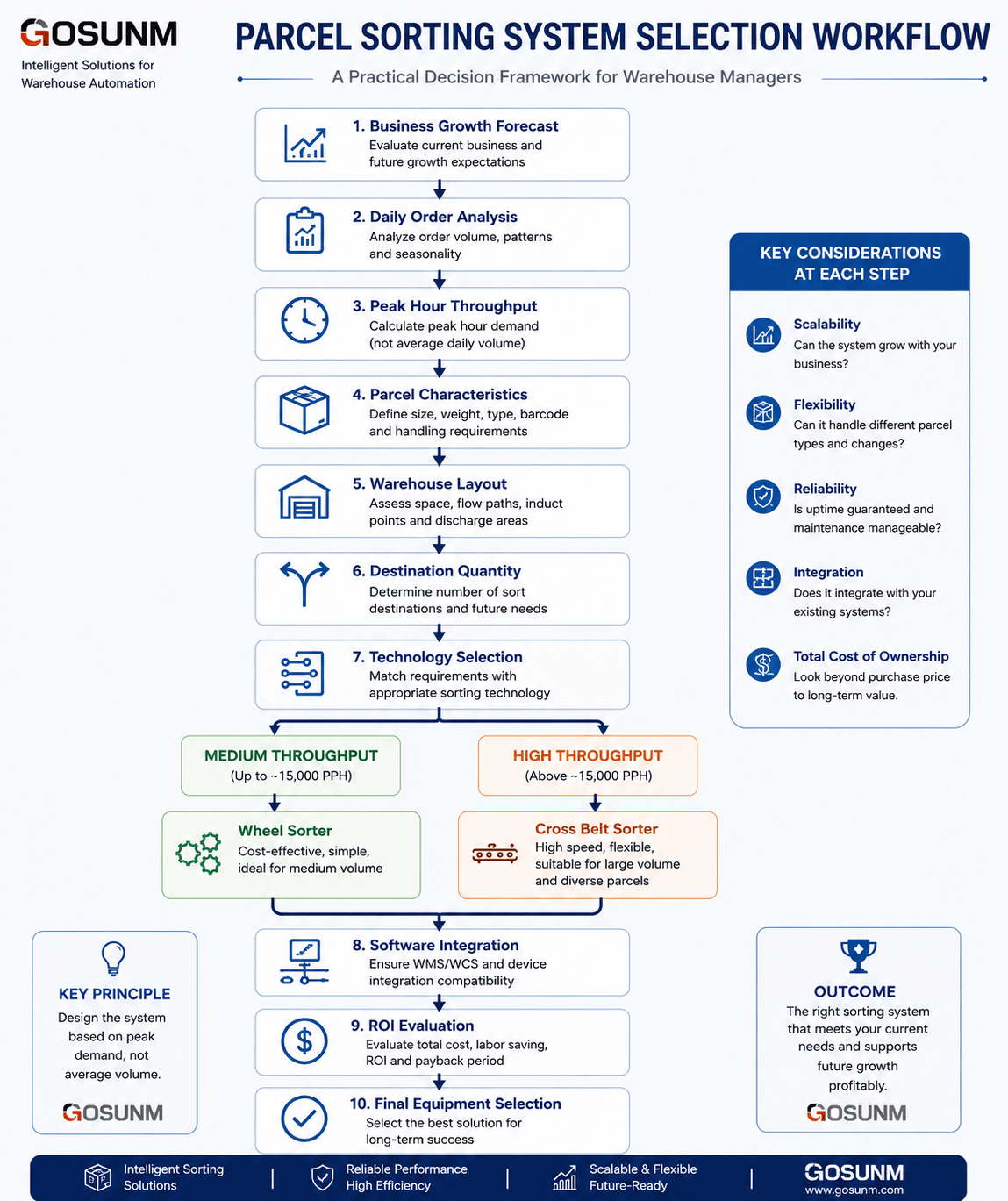
- Step 3: Calculate Peak Throughput Instead of Average Daily Volume
- Step 4: Choose the Right Sorting Technology
- Step 5: Consider the Entire Material Flow
- Step 6: Think Beyond Initial Purchase Price
- Industry Best Practices for Parcel Sorting Projects
- How Different Industries Select Parcel Sorters?
- How to Evaluate Parcel Sorter Suppliers?
- Common Mistakes Buyers Make
- International Standards and Industry References
- Expert Tip
- FAQ
When beginning the selection process, many buyers often focus first on equipment specifications such as sorting speed or conveyor belt width. However, successful projects typically begin at an earlier stage—with a clear understanding of business requirements, parcel characteristics, warehouse workflows, and future expansion plans.
I will outline how experienced warehouse planners evaluate various parcel sorting technologies before selecting a vendor.
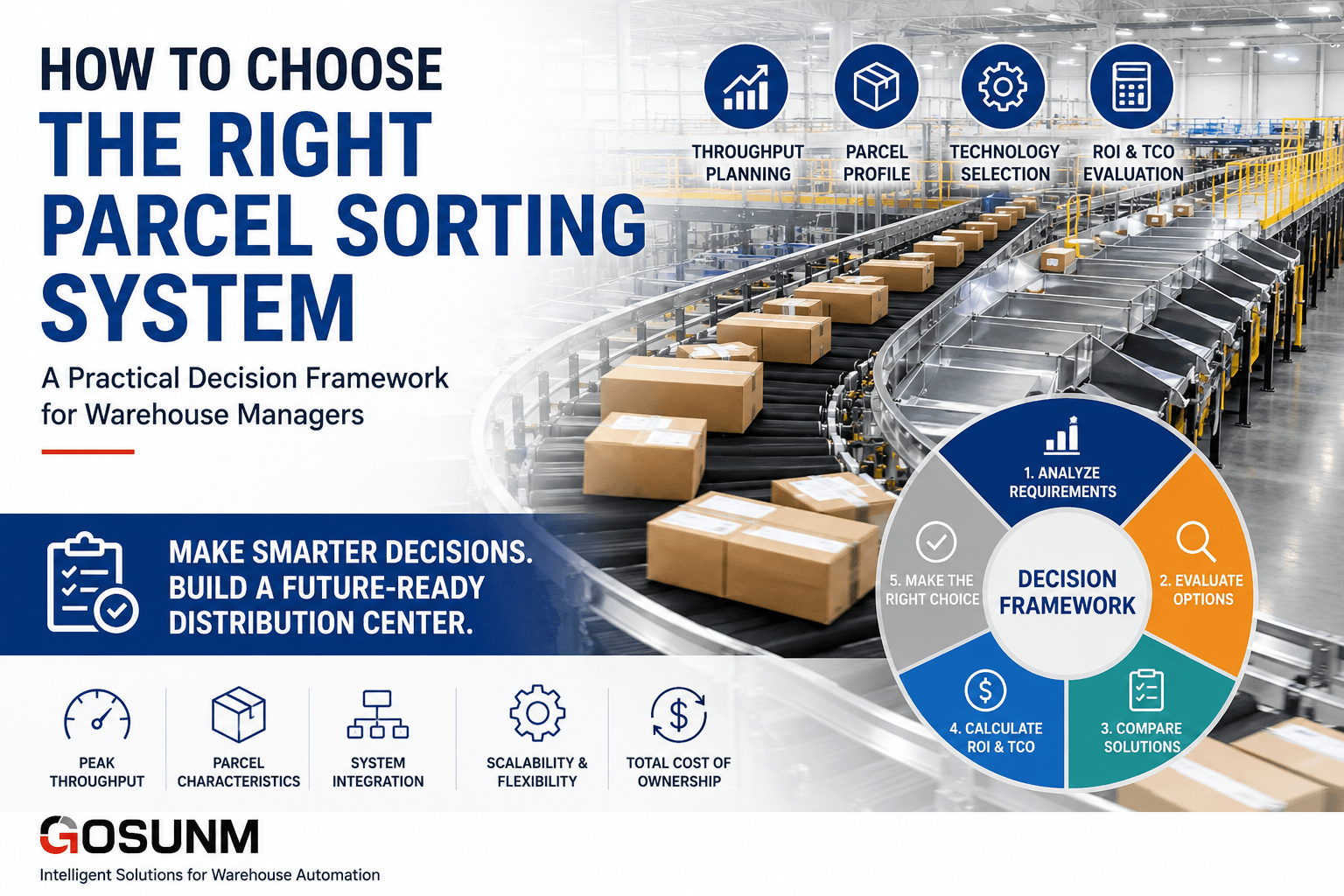
Step 1:Define Your Business Requirements Before Looking at Equipment
The first mistake many companies make is comparing machines before understanding their operational requirements. A parcel sorter should always be selected based on the business process rather than the equipment itself.
Before calculating sorter capacity, gather the following operational information:
| Required Data | Example |
|---|---|
| Daily parcel volume | 120,000 parcels/day |
| Peak operating hours | 8 hours |
| Peak hour concentration | 18% |
| Annual growth rate | 20% |
| Planned service life | 8 years |
| Expected utilization | 80% |
For example, a warehouse processing 50,000 parcels per day may require a very different sorting strategy than another warehouse handling the same daily volume within only one operating shift. The design target should always be peak operating conditions, not average daily production.
Step 2: Understand Your Parcel Profile
Equipment performance depends heavily on the characteristics of the parcels moving through the system.
Before requesting quotations, create a parcel profile including:
| Parameter | Why It Matters |
|---|---|
| Parcel dimensions | Determines conveyor and sorter compatibility |
| Weight range | Influences carrier design and drive systems |
| Packaging type | Cartons, poly bags, mailers and irregular parcels require different handling methods |
| Barcode position | Affects scanning accuracy |
| Fragility | Influences conveying speed and discharge method |
| SKU diversity | Impacts sorting logic and software configuration |
Additional parcel characteristics should also be evaluated:
• Barcode quality (GS1 Grade)
• Barcode orientation
• One-dimensional (1D) or two-dimensional (2D) codes
• Label placement consistency
• Parcel rigidity
• Poly bags versus rigid cartons
• Cylindrical or irregular packages
• Maximum aspect ratio
• Black or reflective packaging
• Return parcels requiring secondary identification
Many sorting problems originate not from the equipment itself but from variations in parcel characteristics that were not considered during the planning stage.
A practical estimation method is: Peak Hour Throughput (PPH)=Daily Parcel Volume×Peak Hour Percentage, If the warehouse operates one primary shift, the sorter should be evaluated against this peak demand rather than the daily average.
Step 3: Calculate Peak Throughput Instead of Average Daily Volume
Average daily volume is one of the most misleading metrics in warehouse automation planning.
Instead, calculate:
Peak Hour Throughput (PHT)=Maximum parcels processed during the busiest hour
Then consider:
- Future business growth
- Equipment utilization rate
- Planned maintenance
- Redundancy requirements
Example:
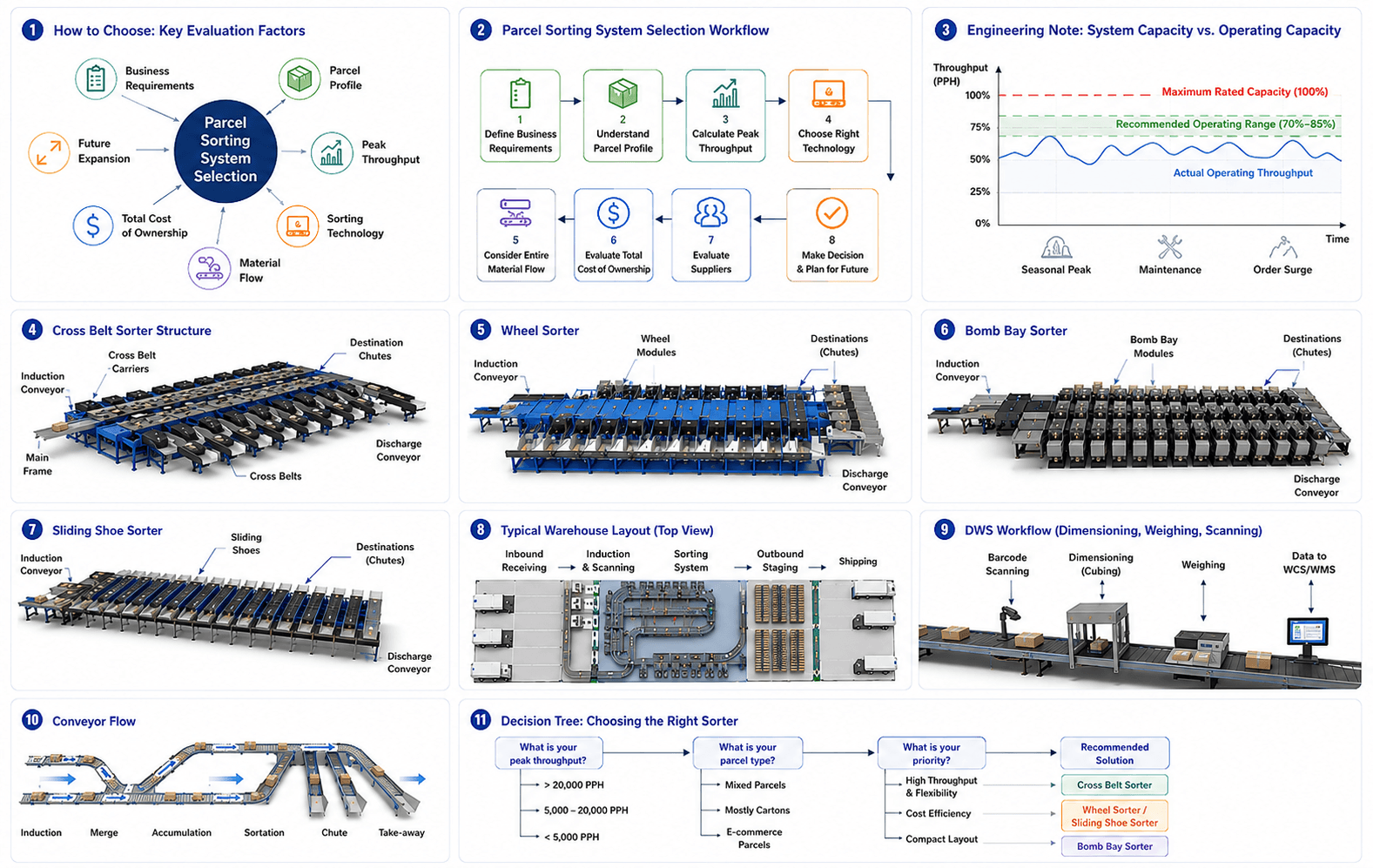
Daily Volume:120,000 parcels, Peak Hour Ratio:18%, Peak Hour Throughput:120,000 × 18%=21,600 parcels/hour, If the expected annual business growth is 20%, the design capacity should accommodate approximately 31,000 parcels/hour after five years. Most warehouse automation engineers recommend operating a sorter at approximately 70–85% of its rated capacity during normal production, leaving sufficient headroom for seasonal peaks, maintenance windows, and unexpected order surges.
Parcel Sorting System Selection Workflow:
Step 4: Choose the Right Sorting Technology
No single sorting technology is ideal for every warehouse. Selection should depend on operational priorities rather than equipment popularity.
| Technology | Capacity (Typical PPH) | Parcel Types | Accuracy | Investment |
|---|---|---|---|---|
| Cross Belt Sorter | 8,000–25,000 | Mixed parcels | Very High | High |
| Wheel Sorter | 2,000–8,000 | Cartons & poly bags | High | Medium |
| Sliding Shoe Sorter | 6,000–18,000 | Rigid cartons | Very High | High |
| Bomb Bay Sorter | 3,000–10,000 | E-commerce parcels | High | Medium |
Step 5: Consider the Entire Material Flow
A parcel sorter is only one component within an automated distribution center.
Overall performance depends on the coordination of multiple systems, including:
- Automatic barcode scanning
- Dimensioning and weighing (DWS)
- Conveyor systems
- Warehouse Control System (WCS)
- Warehouse Management System (WMS)
- Label printing and verification
- Exception handling processes
A high-performance sorter cannot compensate for inefficient upstream processes or poor software integration.
Engineering Note
A sorter's advertised maximum throughput should not be used as the system's daily operating target. Actual performance depends on parcel mix, induction efficiency, barcode readability, destination distribution, software logic, operator practices, and maintenance condition. During system planning, engineers should evaluate the performance of the entire material flow rather than a single piece of equipment.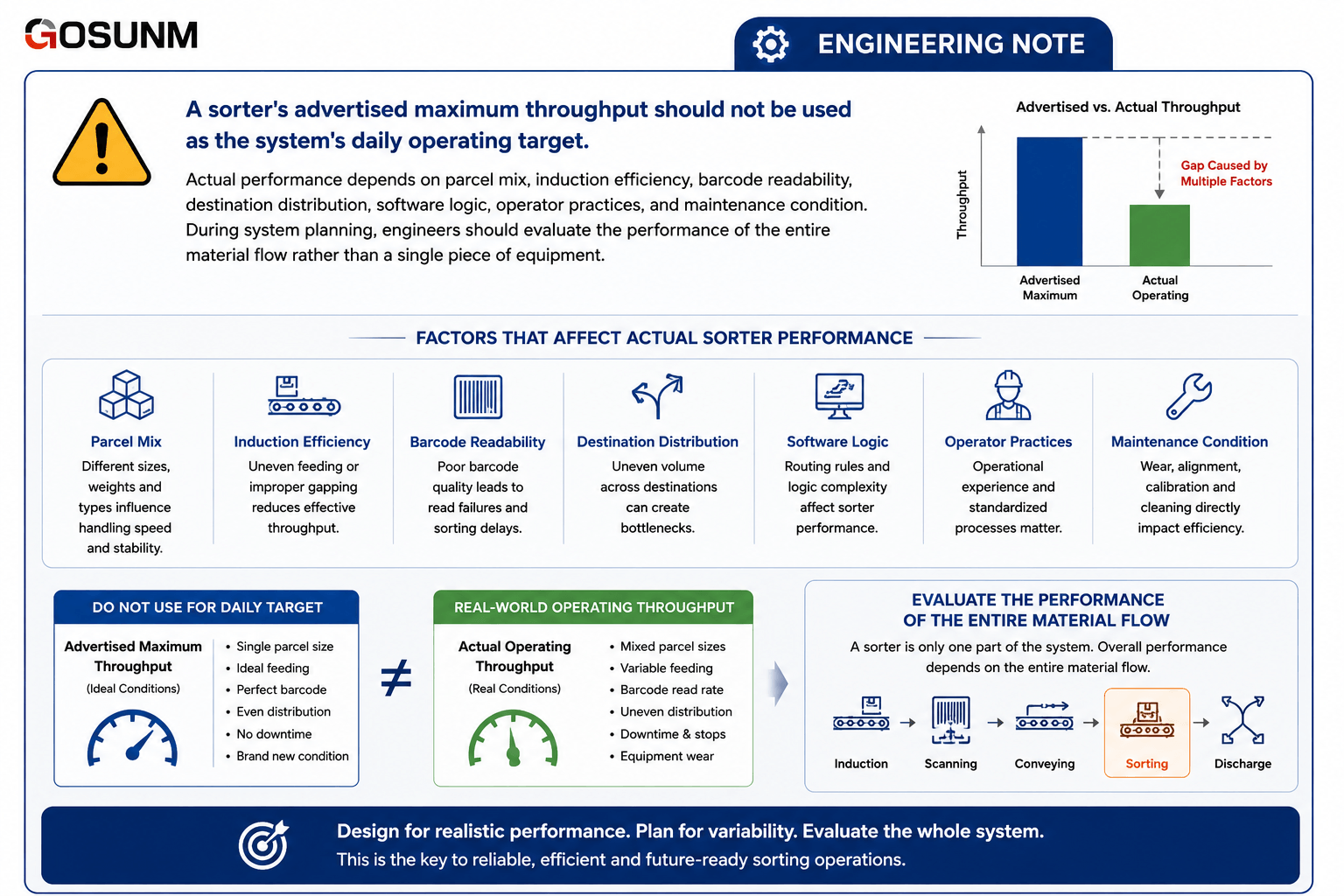
Step 6: Think Beyond Initial Purchase Price
Many companies evaluate suppliers primarily based on equipment cost.
Experienced logistics operators instead compare the Total Cost of Ownership (TCO).
This includes:
- Initial investment
- Software licensing
- Installation
- Commissioning
- Preventive maintenance
- Spare parts
- Energy consumption
- Labor savings
- Future expansion costs
Industry Best Practices for Parcel Sorting Projects
Leading warehouse automation projects generally follow several widely accepted engineering principles:• Conduct operational data analysis before equipment selection.
• Design system capacity based on peak throughput rather than average daily volume.
• Validate barcode quality according to GS1 specifications before commissioning.
• Integrate WCS, WMS, and ERP systems during early project planning.
• Perform simulation analysis to verify conveyor balancing and sorter utilization.
• Reserve sufficient floor space for future capacity expansion.
• Establish preventive maintenance schedules based on equipment lifecycle recommendations.
These practices help reduce implementation risks while improving long-term operational reliability.
Whether you are planning a new distribution center or upgrading an existing warehouse, selecting the appropriate parcel sorting system requires balancing throughput, parcel diversity, software integration, operational flexibility, and long-term ownership costs. At GOSUNM, our engineering team works with customers from the early planning stage through system design, equipment manufacturing, WCS integration, installation, commissioning, and after-sales support. By combining practical project experience with scalable automation technologies, we help logistics operators build efficient and future-ready parcel handling systems tailored to their business growth.
How Different Industries Select Parcel Sorters?
| Industry | Preferred Sorter |
|---|---|
| E-commerce | Cross Belt |
| Apparel | Bomb Bay |
| Pharmaceuticals | Sliding Shoe |
| Postal | Cross Belt |
| Retail Distribution | Wheel Sorter |
| Cold Chain | Chain Conveyor + Shoe |
How to Evaluate Parcel Sorter Suppliers?
Selecting the right parcel sorter supplier is equally important as choosing the appropriate sorting technology. Before making a purchasing decision, warehouse managers should evaluate:• Engineering experience
• Similar project references
• WCS and WMS integration capability
• PLC programming expertise
• Remote diagnostic support
• Spare parts availability
• Preventive maintenance services
• Local installation teams
• System commissioning experience
• Future expansion capability
Many procurement teams use a weighted supplier evaluation matrix rather than comparing equipment prices alone.
Common Mistakes Buyers Make
During warehouse automation projects, several recurring mistakes appear across industries:
- Selecting equipment before analyzing operational data.
- Using average daily volume instead of peak throughput.
- Ignoring future warehouse expansion.
- Underestimating software integration complexity.
- Comparing suppliers solely on equipment price.
- Overlooking maintenance accessibility.
- Failing to evaluate parcel characteristics.
International Standards and Industry References
Material Handling Industry (MHI)
MHI recommends that warehouse automation projects should begin with a comprehensive operational assessment, including order profiles, throughput analysis, inventory characteristics, and future scalability, before equipment selection.
ISO 9001
Automation equipment suppliers should implement quality management processes that ensure design consistency, manufacturing quality, installation control, and continuous improvement throughout the project lifecycle.
GS1 Standards
Barcode quality, identification accuracy, and data consistency are critical factors affecting automatic scanning performance and downstream sorting accuracy.
Poor barcode quality often causes more operational interruptions than equipment failures.
FEM (European Materials Handling Federation)
System planning should consider equipment availability, maintainability, operational safety, and expected lifecycle performance rather than focusing solely on nominal throughput.
Choosing the right parcel sorting system is not simply about selecting the fastest machine or the lowest quotation. Successful warehouse automation projects begin with understanding operational objectives, parcel characteristics, software integration, and long-term business growth. When equipment selection follows a structured decision-making process, organizations are more likely to achieve sustainable productivity improvements, lower operating costs, and greater flexibility for future expansion.
Expert Tip
Successful parcel sorting projects are rarely determined by sorter speed alone. Warehouse engineers should evaluate the complete material handling process—including parcel induction, barcode scanning, DWS accuracy, conveyor balancing, software integration, and exception handling. In many projects, optimizing upstream parcel flow delivers greater productivity gains than simply selecting a faster sorter.
Choosing the right technology is only part of a successful automation project. An experienced supplier should also provide warehouse layout planning, simulation analysis, WCS/WMS integration, installation, operator training, and long-term technical support. GOSUNM has delivered parcel sorting and warehouse automation projects across e-commerce, courier, retail, and third-party logistics industries, helping customers build scalable fulfillment centers tailored to their future growth.
FAQ
What information should I prepare before requesting a quotation for a parcel sorting system?
Prepare data on parcel volume, peak hourly throughput, parcel dimensions, weight distribution, packaging types, destination numbers, warehouse layout, and expected business growth.
How do I estimate the required sorting capacity?
Use peak hourly throughput rather than average daily volume, and include a safety margin to accommodate seasonal demand and future expansion.
Is a higher-speed sorter always a better investment?
Not necessarily. The best solution depends on parcel characteristics, operational requirements, budget, and long-term scalability rather than maximum speed alone.
Should software be considered during equipment selection?
Yes. Integration between the sorting system, Warehouse Control System (WCS), and Warehouse Management System (WMS) plays a critical role in overall system performance.
How can I reduce project risk before purchasing automation equipment?
Conduct a comprehensive operational assessment, define business objectives, analyze parcel profiles, evaluate future expansion needs, and compare solutions based on total lifecycle cost rather than purchase price alone.


 Privacy settings